"To Autumn" is a poem by English Romantic poet John Keats. The work was composed on 19 September 1819 and published in 1820 in a volume of Keats's poetry that included Lamia and The Eve of St. Agnes. "To Autumn" is the final work in a group of poems known as Keats's "1819 odes". The poem has three eleven-line stanzas
which describe a progression through the season, from the late
maturation of the crops to the harvest and to the last days of autumn
when winter is nearing.
Analysis of the poem:
"To Autumn" is one of the last poems written by Keats. His
method of developing the poem is to heap up imagery typical of autumn.
His autumn is early autumn, when all the products of nature have reached
a state of perfect maturity. Autumn is personified and is perceived in a
state of activity. In the first stanza, autumn is a friendly
conspirator working with the sun to bring fruits to a state of perfect
fullness and ripeness. In the second stanza, autumn is a thresher
sitting on a granary floor, a reaper asleep in a grain field, a gleaner
crossing a brook, and, lastly, a cider maker. In the final stanza,
autumn is seen as a musician, and the music which autumn produces is as
pleasant as the music of spring — the sounds of gnats, lambs, crickets,
robins and swallows.
In the first stanza, Keats concentrates on the
sights of autumn, ripening grapes and apples, swelling gourds and hazel
nuts, and blooming flowers. In the second stanza, the emphasis is on the
characteristic activities of autumn, threshing, reaping, gleaning, and
cider making. In the concluding stanza, the poet puts the emphasis on
the sounds of autumn, produced by insects, animals, and birds. To his
ears, this music is just as sweet as the music of spring.
The ending of the poem is artistically made to
correspond with the ending of a day: "And gathering swallows twitter in
the skies." In the evening, swallows gather in flocks preparatory to
returning to their nests for the night.
"To Autumn" is sometimes called an ode, but Keats
does not call it one. However, its structure and rhyme scheme are
similar to those of his odes of the spring of 1819, and, like those
odes, it is remarkable for its richness of imagery. It is a feast of
sights and sounds.
Here is only two main character 1) Old Man 2) Narrator: Who live with old man. To read more about character of Narrator click here.
Summary: An unnamed narrator opens the story by addressing the
reader and claiming that he is nervous but not mad. He says that
he is going to tell a story in which he will defend his sanity yet
confess to having killed an old man. His motivation was neither
passion nor desire for money, but rather a fear of the man’s pale
blue eye. Again, he insists that he is not crazy because his cool
and measured actions, though criminal, are not those of a madman.
Every night, he went to the old man’s apartment and secretly observed
the man sleeping. In the morning, he would behave as if everything
were normal. After a week of this activity, the narrator decides,
somewhat randomly, that the time is right actually to kill the old
man.
When the narrator arrives late on the eighth night, though,
the old man wakes up and cries out. The narrator remains still,
stalking the old man as he sits awake and frightened. The narrator
understands how frightened the old man is, having also experienced
the lonely terrors of the night. Soon, the narrator hears a dull
pounding that he interprets as the old man’s terrified heartbeat.
Worried that a neighbor might hear the loud thumping, he attacks
and kills the old man. He then dismembers the body and hides the
pieces below the floorboards in the bedroom. He is careful not to
leave even a drop of blood on the floor. As he finishes his job,
a clock strikes the hour of four. At the same time, the narrator
hears a knock at the street door. The police have arrived, having
been called by a neighbor who heard the old man shriek. The narrator
is careful to be chatty and to appear normal. He leads the officers
all over the house without acting suspiciously. At the height of
his bravado, he even brings them into the old man’s bedroom to sit
down and talk at the scene of the crime. The policemen do not suspect
a thing. The narrator is comfortable until he starts to hear a low
thumping sound. He recognizes the low sound as the heart of the
old man, pounding away beneath the floorboards. He panics, believing
that the policemen must also hear the sound and know his guilt.
Driven mad by the idea that they are mocking his agony with their
pleasant chatter, he confesses to the crime and shrieks at the men
to rip up the floorboards.
Jane Austen was an English novelist known primarily for her six major novels, which interpret, critique and comment upon the British landed gentry at the end of the 18th century. She was very creative minded and very intellectual. She has got creative atmosphere at home for witting. . Austen's plots often explore the dependence of women on marriage in
the pursuit of favorable social standing and economic security. She write many novels in which some of them mansion as billow. Her novel's are,
Sense and Sensibility is a novel by Jane Austen, published in 1811. It tells the story of the Dashwood sisters, Elinor (age 19) and
Marianne (age 16 1/2) as they come of age. They have an older, stingy
half-brother, John, and a younger sister, Margaret, 13. The novel follows the three Dashwood sisters as they move with their
widowed mother from the estate on which they grew up, Norland Park, to
their new home, Barton Cottage. The four women must move to a meagre
cottage on the property of a distant relative, where they experience
love, romance, and heartbreak. The novel is likely set in southwest England, London and Sussex between 1792 and 1797.
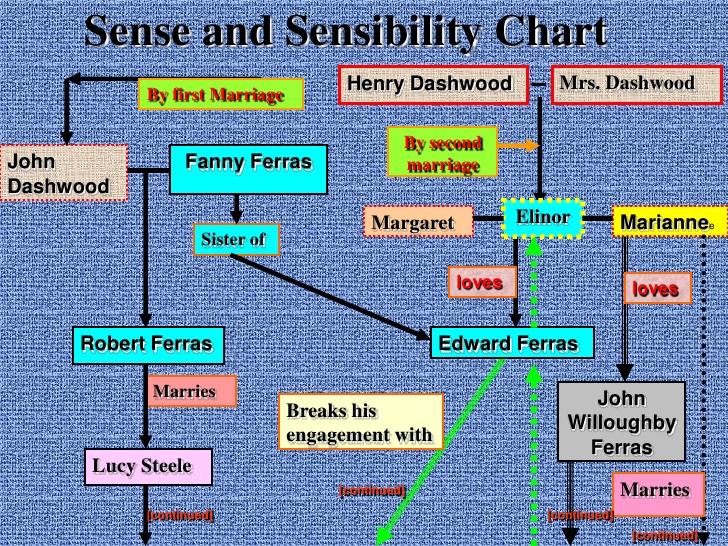
Character Chart:
Plot of the novel:
This is the story of Elinor and Marianne
Dashwood, sisters who respectively represent the "sense" and
"sensibility" of the title. With their mother, their sister Margaret,
and their stepbrother John, they make up the Dashwood family.
Henry Dashwood, their father, has just died.
Norland Park, his estate, is inherited by John; to his chagrin, Henry
has nothing but ten thousand pounds to leave to his wife and daughters.
On his deathbed, he urges John to provide for them and John promises
that he will do so. He is already wealthy because he has a fortune from
his mother and is also married to the wealthy Fanny Ferrars.
Immediately after Henry's burial, the insensitive
Mrs. Dashwood moves into Norland Park and cleverly persuades John not
to make any provision for his stepmother and stepsisters. Mrs. Henry
Dashwood, disliking Fanny, wants to leave Norland Park at once, but
Elinor prudently restrains her until they can find a house within their
means.
Edward Ferrars, Fanny's brother, comes to stay
and is attracted to Elinor. Mrs. Dashwood and Marianne expect an
engagement, but Elinor is not so sure; she knows that Mrs. Ferrars and
Fanny will object to Edward's interest in her. Fanny takes exception to
Edward's fondness for Elinor and is so rude that Mrs. Dashwood at once
rents a cottage fortuitously offered to her by her cousin, Sir John
Middleton.
The Dashwoods move to Barton Cottage and are met
by Sir John, who does all in his power to make them comfortable. They
soon meet his elegant but insipid wife and their four children.
One day, when Marianne and Margaret are walking
on the downs, Marianne sprains her ankle. She is carried home by a
stranger, John Willoughby, who is staying at Allenham Court, a country
estate which he will inherit after the death of its elderly owner, Mrs.
Smith. Marianne and Willoughby fall in love and are inseparable. But
after a short time, Willoughby leaves unexpectedly for London without
explaining or declaring himself.
Edward Ferrars soon pays a visit to Barton Cottage. But he is distraught and gloomy, and Elinor is puzzled by his reserve.
Lady Middleton's mother, Mrs. Jennings, has been
staying at Barton Park. She teases Marianne about Colonel Brandon, a
friend of Sir Henry, who obviously admires Marianne. Though she likes
the colonel, Mrs. Jennings repeats some scandal about him; he is said to
have an illegitimate daughter, Miss Williams.
Lady Middleton's younger sister, Charlotte
Palmer, and her husband visit Barton Park. When they leave, Sir John
invites the Misses Steele, two young ladies whom he has met in Exeter
and has found to be connections of Mrs. Jennings.
Lucy confides to Elinor that she has been
secretly engaged to Edward Ferrars for four years. He was tutored by her
uncle and became well acquainted with Lucy and Anne at that time.
Elinor is shocked but concludes that Edward had a youthful infatuation
for Lucy. Lucy persists in asking for advice and begs Elinor to persuade
her brother John to give Edward the Barton living if he decides to take
orders.
Mrs. Jennings invites Elinor and Marianne to stay
with her in London. Marianne is eager to go because she hopes to see
Willoughby there. He has not been back to visit them, nor has he written
to Marianne.
In London, Marianne waits for a visit from
Willoughby. She writes him several times but receives no reply. One day
he leaves his card but never calls personally.
Finally, Elinor and Marianne see Willoughby at a
dance with a fashionable heiress, Miss Grey. He speaks curtly to
Marianne, who is distracted by his coldness. She writes him for an
explanation, and he returns her letters with a cruel note, denying that
he had ever been especially interested in her and announcing his
engagement to Miss Grey.
Colonel Brandon, who is also in London, is
distressed by Willoughby's conduct to Marianne and tells Elinor his own
story. As a young man, he had loved his cousin Eliza, his father's ward.
But to gain Eliza's fortune, his father had married her to his eldest
son, who had treated her badly. Years later, the colonel discovered that
Eliza had left her husband for another man. She had sunk lower and
lower, and was now penniless and on her deathbed. The colonel did all he
could for her and promised to bring up her daughter, also named Eliza.
Eliza, now grown, had been seduced by Willoughby, who had deserted her.
The colonel had fought a duel with Willoughby, but neither had been
injured.
John Dashwood and his wife come to London for the
season. He meets his sisters and is introduced to the Middletons, whom
he finds very congenial. Anne and Lucy Steele are invited to stay with
the Middletons and eventually pay a visit to the Dashwoods, John and
Fanny. They are treated so kindly that Anne feels it is safe to break
the secret of Lucy's engagement to Edward.
Fanny Dashwood has hysterics and orders Lucy and
Anne out of her house. Edward's mother disinherits him because he will
not break his word to Lucy. He decides to take orders and offers to free
Lucy from her engagement, but Lucy will not give him up.
Charlotte Palmer's son is born, and she invites
Elinor and Marianne to accompany her mother on a visit to her country
house, Cleveland. Marianne falls ill there and seems near death. Colonel
Brandon is also staying at Cleveland and offers to fetch Mrs. Dashwood.
The Palmers leave their house, fearing infection
for the baby, and while Elinor awaits her mother's arrival, she is
amazed by a visit from Willoughby. He has heard of Marianne's illness
and has come to get news of her. He tells Elinor how bitterly he repents
of his conduct and how wretched his wife has made him; it was she who
dictated the cruel note which he sent to Marianne. Elinor is sorry for
him.
Marianne recovers and the family returns to
Barton Cottage. Eventually, Elinor tells Marianne about Willoughby's
repentant visit. Marianne is now sorry that the family has suffered on
her behalf.
One day, a servant tells them that Edward Ferrars
is married. Elinor tries to put him out of her mind; however, he
arrives at Barton Cottage and explains that Lucy did not marry him;
instead, she eloped with his brother, Robert.
Everything ends happily. Edward is reconciled to
his mother and marries Elinor. He takes orders and is given the living
at Delaford, Colonel Brandon's estate. Eventually Marianne agrees to
marry the colonel, and the two couples live happily, close in distance
and in friendship.
Thank you... I have taken this plot of the novel from this site. https://www.cliffsnotes.com/literature/s/sense-and-sensibility/book-summary
Oliver Twist, is written by Charles Dickens. It is the second novel by him, and it was first published as a serial 1837–39. The sub title of the novel is The Parish Boy's Progress. The story centers on orphan Oliver Twist, who born in a workhouse and sold into apprenticeship with an undertaker.
Plot Overview:
Oliver Twist is born in
a workhouse in 1830s England. His mother,
whose name no one knows, is found on the street and dies just after
Oliver’s birth. Oliver spends the first nine years of his life in
a badly run home for young orphans and then is transferred to a
workhouse for adults. After the other boys bully Oliver into asking
for more gruel at the end of a meal, Mr. Bumble, the parish beadle,
offers five pounds to anyone who will take the boy away from the
workhouse. Oliver narrowly escapes being apprenticed to a brutish
chimney sweep and is eventually apprenticed to a local undertaker,
Mr. Sowerberry. When the undertaker’s other apprentice, Noah Claypole,
makes disparaging comments about Oliver’s mother, Oliver attacks
him and incurs the Sowerberrys’ wrath. Desperate, Oliver runs away
at dawn and travels toward London.
Outside London, Oliver, starved and exhausted, meets
Jack Dawkins, a boy his own age. Jack offers him shelter in the
London house of his benefactor, Fagin. It turns out that Fagin is
a career criminal who trains orphan boys to pick pockets for him.
After a few days of training, Oliver is sent on a pickpocketing
mission with two other boys. When he sees them swipe a handkerchief
from an elderly gentleman, Oliver is horrified and runs off. He
is caught but narrowly escapes being convicted of the theft. Mr.
Brownlow, the man whose handkerchief was stolen, takes the feverish
Oliver to his home and nurses him back to health. Mr. Brownlow is
struck by Oliver’s resemblance to a portrait of a young woman that
hangs in his house. Oliver thrives in Mr. Brownlow’s home, but two
young adults in Fagin’s gang, Bill Sikes and his lover Nancy, capture
Oliver and return him to Fagin.
Fagin sends Oliver to assist Sikes in a burglary. Oliver
is shot by a servant of the house and, after Sikes escapes, is taken
in by the women who live there, Mrs. Maylie and her beautiful adopted
niece Rose. They grow fond of Oliver, and he spends an idyllic summer with
them in the countryside. But Fagin and a mysterious man named Monks
are set on recapturing Oliver. Meanwhile, it is revealed that Oliver’s
mother left behind a gold locket when she died. Monks obtains and
destroys that locket. When the Maylies come to London, Nancy meets
secretly with Rose and informs her of Fagin’s designs, but a member
of Fagin’s gang overhears the conversation. When word of Nancy’s
disclosure reaches Sikes, he brutally murders Nancy and flees London.
Pursued by his guilty conscience and an angry mob, he inadvertently
hangs himself while trying to escape.
Mr. Brownlow, with whom the Maylies have reunited Oliver, confronts
Monks and wrings the truth about Oliver’s parentage from him. It
is revealed that Monks is Oliver’s half brother. Their father, Mr.
Leeford, was unhappily married to a wealthy woman and had an affair
with Oliver’s mother, Agnes Fleming. Monks has been pursuing Oliver
all along in the hopes of ensuring that his half-brother is deprived
of his share of the family inheritance. Mr. Brownlow forces Monks
to sign over Oliver’s share to Oliver. Moreover, it is discovered
that Rose is Agnes’s younger sister, hence Oliver’s aunt. Fagin
is hung for his crimes. Finally, Mr. Brownlow adopts Oliver, and
they and the Maylies retire to a blissful existence in the countryside.
Stoppingby woods on a snowy evening is one of the most celebrated poems of Robert Frost. The first prime minister of independent India Pandit Javaharlal Nehru was so much impressed with the message of this poem that he always kept this poem on the table beneath the glass. The poem is simple but the message which it conveys that issignificant. The poem is about poets going to the forest and getting tempted to stay their and finally realising that he has many works to be done by him and so he can not stop in the forest. This present poem is about the internal dilemma of the poet's between love for beauty and sense of duty. This kinds of dilemma is witnessed by every person at some stage in life. We all are some times tempted by beauty of nature to stop their for long time but the work which is to be done by us.
The subject matter of the poem is simple the poet goes to a dark deep lovely forest on his horse back. It is such a beautiful place that the poet is tempted to stop there and past that night in the forest but the horse of the poet shakes its head to ring the balls which are tide to its harness. The horse wants to ask the poet whether he is mistaken in making a stay in that Forest. The reason behind it is the darkness evening, lack is frozen and the snow fall is there. So gesture of his horse reminds the poet that the woods are lovely dark and deep but he has so many promises to keep. He has to perform many duties before he sleeps in the forest and before he dies. The final message of the poem is that sense of beauty in life is more important than tempting beauty. No tempting beauty should ever prove to bed a hindrance on the path of duty.
Here is video of poem with beautiful picture and text.
The land was ours before we were the land's. She was our land more than a hundred years Before we were her people. She was ours In Massachusetts, in Virginia, But we were England's, still colonials, Possessing what we still were unpossessed by, Possessed by what we now no more possessed. Something we were withholding made us weak Until we found out that it was ourselves We were withholding from our land of living, And forthwith found salvation in surrender. Such as we were we gave ourselves outright (The deed of gift was many deeds of war) To the land vaguely realizing westward, But still unstoried, artless, unenhanced, Such as she was, such as she would become.
Robert Frost
Analysis of the poem:
The gift outright is a poem by Robert Frost, which is deals
with a serious issue of the United States. It is about a constant conflict
going on between the native people of America and the settlers of colonizers
who made UAS their permanent home. The poem is addressed by a descendent of the
settler and it is address to the native community. The poem is in fact a
request of the descendent to the native of the people to accept the settlers as
one part of native community.
The poem opens
with the tone of a request in which the descendent of settlers says that he has
accepted that country as his motherland but still he has not been accepted as a
native but people of that country the descendent consider every state of the US
as his home but still he has treated as a colonizer and as outsider by the
people of that country it is this difference which pains the descendent.
The descendent
admits that, for a long spam of time he himself and many other descendent remained
aloof and did not mix with native community. But a change has come in the
attitude of the descendents and he has surrendered to the native people. The
settlers have realized that there is no salvation for them if there is no
surrender from their side. This descendent in the present poem would like to himself
as a gift to the native people. His request to the native people is to see that
he is accepted as a gift and not rejected.
The present
poem can be considering a polite request of the descendent of colonizers to
accept all descendents of as the native people of America. He agrees that in
the past many conflicts and wars taken place but that has not sold the problem
of conflict between the native people and colonizers. So he wants to offer
himself as a gift to the native people. The descendents of colonizer may be
artless, without enhancement and without any story of their own but he would be
happy if his accepted as gift. Robert Frost himself experienced this conflict
between the native and the settlers and here he try to give a solution to that
problem of conflict between native and colonizer can be solved only with love,
violence has no place in it.
(3) (If)You
have studied ‘Genesis’ (The Bible), ‘The Paradise Lost’ (John Milton)
and ‘The Da Vinci Code’ (Dan Brown). Which of the narrative/s seem/s to
be truthful? Whose narrative is convincing to the contemporary young
mind?
Among all of three narratives, novel Da vinci cod’s narrative is more convincing to the contemporary young generation. In his novel we see very strong narrative with such strong evidence that we have to accept it. On the other hand we see the narrative of Genesis (it is chapter of the Bible). In which we see the story of Adam and Eve which was far away from reality.In Paradise Lost Milton tell same story from Bible but in which he do some change and Eve became more rational character and she ask question after eating forbidden fruit. The story of Bible is shown as reality of world but it has not any evidence about it. Now a day’s generation believes in evidence which was very good represented in Dan Brown’s novel ‘Da vinci code’. In which we see the question on religion which was not blindly follow by people. In this narrative we see some doubt and also talks in favor of freeing the human from the shackles of religious norms. So this novel’s narrative is more convincing then, Milton’s paradise lost or Bible.
(4) What
harm has been done to humanity by the biblical narration or that of
Milton’s in The Paradise Lose? What sort of damage does narrative like
‘The Vinci Code’ do to humanity?
In the Bible and Paradise lost shown fall of mankind because of female. Eve was one who ate the forbidden fruit first so; she was responsible for fall of mankind. So here we see that people first attacks on female as unworthy and reason for downfall of human kind. In Christianity Bible doesn’t allow people to ask questions so their knowledge about religion is become very shallow. In ‘Da vinci code’ novel also female character Sophie is presented with wisdom and strength in the beginning of the novel but when to male are talking and discussing on the knowledge of history or art at that time she looks like dumb woman. So always people keeping woman away from knowledge and blaming on her.
(6)Do
novel / film lead us into critical (deconstructive) thinking about your
religion? Can we think of such conspiracy theory about Hindu religious
symbols / myths?
Of course this type of the novel or movie leads to deconstruct religion or doubting on it. It raises many doubts in our mind about religion. We have many great religious books like Mahabharata, Bhagvatgita, Ramayana etc... In which I would like to give one example from Ramayana. In which we see Ram as God but many narrative has proved that Ram was not God but he was great human. In Amish Tripathi’s novel “Scion of Ikshvaku” he wrote that,
“Ram and Lakshaman made their way through the dense jungle. Ram walked in front varying one end of a long staff on his shoulder, while Lakshaman Walked behind holding up the other end. The deer’s carcass dangles in the middle, its feet having been secured to the staff with a study rope.
‘Aah, a decent meal after so many days’. Said by Lakshaman” - Tripathi
Through this dialogue of Lakshaman the image of Ram and Lakshaman as a vegetarian was deconstructed. So, we have many example like this which was leads us into deconstructive thinking about religion. (7) Have
you come across any similar book/movie, which tries to deconstruct
accepted notions about Hindu religion or culture and by dismantling it,
attempts to reconstruct another possible interpretation of truth?
Yes, the movie like, Oh My God or P.K. which tries to question on the religion, It also tries to redefines what is been followed blindly by people. In the movie Oh My God we see that hero of the movie Kanjibhai who do the case against God because his antic shop was destroyed in earthquake. He believes that his shop destroyed because of god. So here we see that he question against God which break the stereo type mindset of the society and question against God also.
(8) When
we do traditional reading of the novel ‘The Da Vinci Code’, Robert
Langdon, Professor of Religious Symbology, Harvard University emerges as
protagonist and Sir Leigh Teabing, a British Historian as antagonist. Who will claim the position of protagonist if we do atheist reading of the novel?
Leigh Teabing will claim the protagonist if we do atheist reading of the novel. He was in the favor to destroy the grail in order to free people from any kind of fear.
(9)Explain Ann Gray’s three propositions on ‘knowability’ with illustrations from the novel ‘The Da Vinci Code’.
Ann Gray describe three proposition on knowability that can we apply in the novel “ The Da vinci cod” because in the novel one of the major question is about ‘identity’ and ‘knowledge about the self’. Ann Gray’s three proposition of knowability. (A) Identifying what is knowable. This is an ontological question; it refers to the aspect of social reality to be studied but also deals with assumptions. We are willing to make about the nature of reality. This is very waste concept and one cannot claim that whatever we know is truth. Character like Silas dies in blindness about his knowledge. (B) Identifying and acknowledging the relationship of the knower and the known. This is epistemological question and put simply asks how we know that we know. In the novel Silas don’t know who the teacher is but then also he works for him and killed so many people under the order of the teacher. (C) What is the procedure for knowing? This is the methodological question so in this we come to know that there are many ways to find out the things. In this novel procedure for knowing we find in the character of Sophie Neveu. She knows about here self that she belongs to royal blood line of Jesus Christ after slowing many riddle.
So this three questions are very much related to the novel because one of the major thing of the novel is that; knowledge and knowability. So for that perspective understanding of these things from Ann Gray’s book is very helpful.